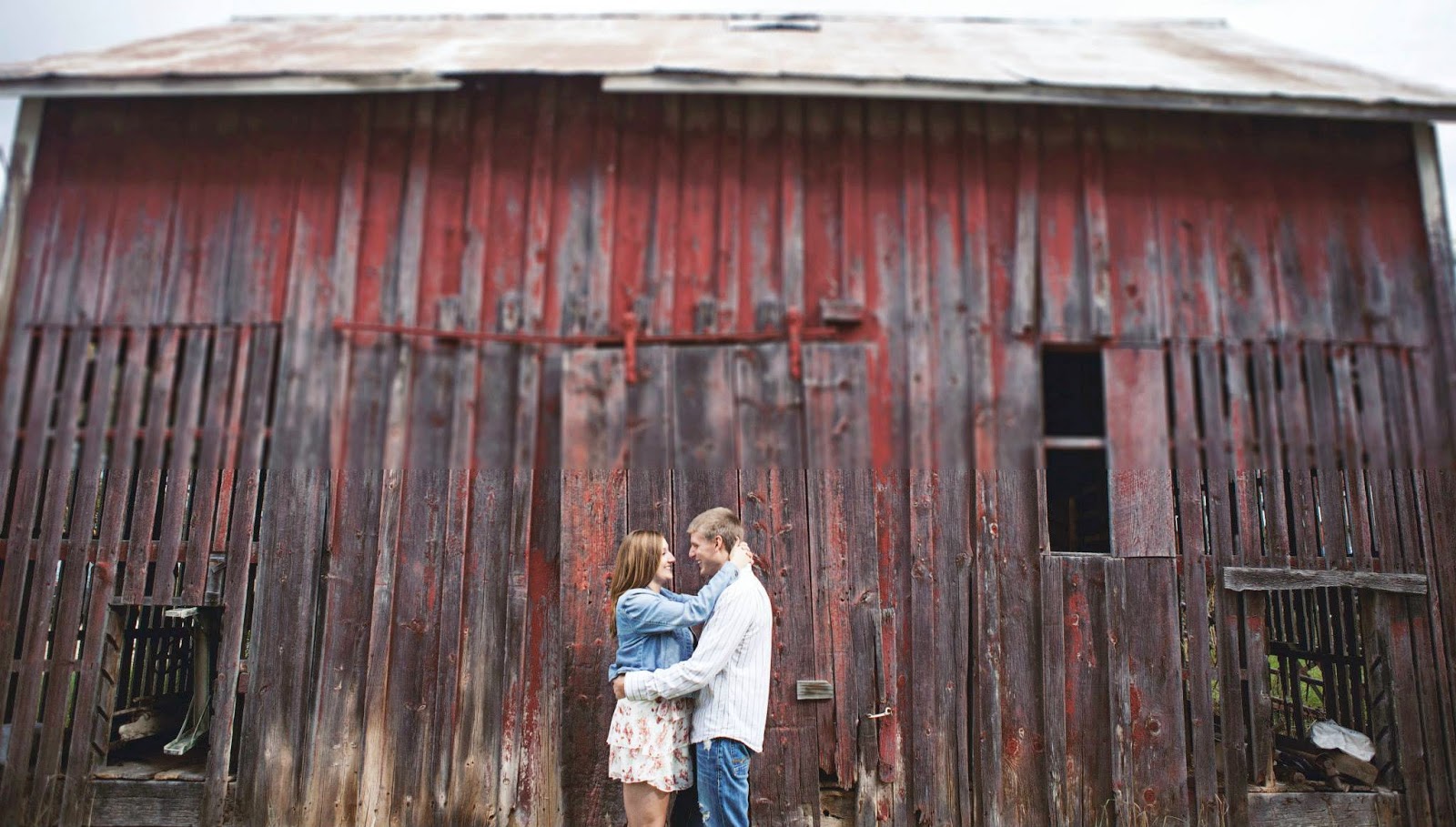
My
background in farming consists of this: my dad grew up on a farm and I was in
4-H as a kid (and no, I did not show animals). That's it. Or it WAS until my
world was completely flipped upside down and spun around when I married a farm
girl.

The first time
I visited my – girlfriend at the time, now wife – Amy's, family farm I was
given the task of picking rocks in one of the fields. Her dad literally plunked
us in the middle of a field with a wagon and a tractor and told us to pick up
rocks. I mean I had heard the phrase 'rock picking' before but never had a desire
to participate.
If it was
supposed to drive me away, it didn't work. I returned.
I think I started
winning her family over when I continued to come back even after the most
ridiculous tasks. One time I even got attacked by a coughing cow (Just take a moment to think about that). One of the most memorable moments early in
our relationship was when we were standing in the farm house kitchen and we look
out the window to see a heifer staring back at us. I learned right then and
there. It doesn't matter the time of day or what you are wearing: if someone
yells "COWS ARE OUT". You run…and fast.
 I have now
been fully immersed by the "farmer schedule." As someone not used to the long,
physically laborious days, it's exhausting. Often when at the in-laws, I help milk and feed the cows, feed calves and clean the parlor…which is a
never-ending task.
I have now
been fully immersed by the "farmer schedule." As someone not used to the long,
physically laborious days, it's exhausting. Often when at the in-laws, I help milk and feed the cows, feed calves and clean the parlor…which is a
never-ending task.
I'm not
afraid to admit the calves are my favorite. When they're not head-butting you
between the legs – which is a less than pleasant feeling – they're just so darn
cute and relaxing. I've heard of dog therapy before, but is there such a
thing as calf therapy? If not, I may have discovered it. Often, I'm found snapping pictures with the little buggers. People say photos and video of cats rule the Internet, but I think it's just a matter of time before calves get their
time to shine.

Growing up I didn't give much thought to where my food came
from. It's not that I was blind to the agriculture world, but I hadn't
experienced it first-hand and had little connection to it. As with many consumers, the thought didn't go much beyond food comes from the
grocery store. I didn't understand the battles today's farmers experience every
day...or, in fact, the joys their profession brings. There is a disconnect
between the average consumer and the American farmer, more so than there was a few generations ago. That's why it is so important to help share agriculture's story.
Now, even though you may not be a farmer, you may be closely connected to agriculture because of a friend or family member. You are valuable to agriculture. I want to share a story about a girl in Texas who just might be the perfect example of why you need to speak up for agriculture.
Kendyll Williams is a young girl from Fort Worth, Texas. She has been criticized by animal activists for selling her market steer at the Fort Worth Stock Show. (Animal activists believe animal agriculture of any kind is inhumane.) Her steer, Oatmeal, was born blind and certainly didn't show much promise for a good show animal. But, Kendyll who is 13 had a goal to get Oatmeal to the Sale of Champions and raise some money along the way to purchase more steers and eventually pay for college. Oatmeal advanced to the sale and was sold for $8,000. Kendyll said her goodbyes to the animal she had raised and developed a trusting relationship with just like many others in the beef industry have done and will do.
If you have shown beef animals before, you know first-hand how hard it is sometimes to watch them be loaded onto a truck, but it's part of the process and part of the circle of life. (Cue Lion King melody??)
Oatmeal was transported with dozens of other steers to a meat processing plant. The local newspaper published a story the following week about Kendyll and her steer. That's when the Internet trolling began. Many readers commented they were outraged that the steer had been sold for slaughter. Others did show their support, but it's the hateful and vicious comments that leave the lasting impact, especially to a 13-year old girl.
Some accused her of being heartless. Others were shocked she could kill an animal after growing so close to it. Some comments stick out to me like, "Can we start a Go Fund Me page to help the family keep the steer until its natural death?" or "Cruel. I'm sorry but either keep him or see to his safe passage beyond. Poor thing must have been beside himself leaving her and carted to death in a strange, most likely inhumane, slaughterhouse."
Beside himself? I don't know about you but I have never seen a steer 'beside himself' before…
After the first story ran, a
Facebook page -- Oatmeal Blind Steer -- was created and animal rights activists were trying to save the steer from entering the food chain. All of the
commotion worked because Oatmeal was "saved" from the meat
packaging plant and donated to Texas A&M for research. Which many were still not happy about.
You give activists an inch and they'll want a mile. The extremists out there want him at a sanctuary, period; here he can live a happy life as a pet. These activist groups are harassing the family who raised the steer, making constant phone calls to Texas A&M and the company that purchased the steer. They will not stop until they "free" this animal. Is it a realistic battle? Absolutely not. I'm sure though, if asked, many would say they would like to free every animal on every feedlot. Perhaps they would much rather see cattle cease to exist altogether and meat taken off the dinner table completely.
You give activists an inch and they'll want a mile. The extremists out there want him at a sanctuary, period; here he can live a happy life as a pet. These activist groups are harassing the family who raised the steer, making constant phone calls to Texas A&M and the company that purchased the steer. They will not stop until they "free" this animal. Is it a realistic battle? Absolutely not. I'm sure though, if asked, many would say they would like to free every animal on every feedlot. Perhaps they would much rather see cattle cease to exist altogether and meat taken off the dinner table completely.
 This is our reality in
agriculture…this is what we are facing.
This is our reality in
agriculture…this is what we are facing.
This story isn't about a lack of compassion for an impaired animal.
Livestock shows teach youth invaluable skills, work ethic and life lessons,
including the responsibility of treating animals with respect and the
importance of raising quality animals for nutritious food. The family knew
the ultimate purpose of this steer from the get-go, and that's what cattle
are raised for -- to produce quality beef for families around the globe. We
can't go "saving" every steer that a group of activists wants.
Unfortunately, we live in a
society where people see little difference between pets and livestock.
It has been proven time and
time again that social media can create a firestorm of outrage. We must stand
together to combat this firestorm. There's power in numbers. These activists
don't have more numbers, they're just louder. Which is why they're successful.
We can be loud too! We must be louder.
So what can
we do when eaters, even some highly-educated health professionals, don't understand agriculture
and what it takes to produce the food on their plate?
 Share.
 Share. And be there to connect people to farmers.
Share.
Share. Share. And be there to connect people to farmers.
When the
general public thinks of farmers or the ag-industry they think of little
red barns. They may even think of the word "hicks." They think of ma and pa getting
up at the crack of dawn and milking some cows by hand. My weekends at the farm
are far from a vacation, They generally consist of 15-plus hour days, and
they’d be even longer if we had to milk all 200 cows by hand! Plus, we’re not
just up to milk and then head home to flip on the TV…to see what the
Kardashians are up to. There’s so much more to Wisconsin agriculture than just
getting the job done, and even in the great state of Wisconsin, where farming
is at our roots and a part of our lifestyle, people don’t understand about the
day-to-day operations of a modern working farm. Many don't get the amount of
work and dedication that goes into keeping the farm afloat, let alone the pride every farmer I know glows with. So get out there and share that with the
public.

We opened up
the doors for anyone and everyone to stop in and see up-close what a working
farm looks like. We welcomed questions, and clarified the misconceptions like
how there is no antibiotics in your milk. We showed them the bucket the
cow-treated-with-antibiotic's milk goes into and explained that it would get
dumped down the drain: not go in the tank with the other milk.
 This "open
barn" event has continued and grown. We had a pretty cool moment happen last
year when we actually had a calf born at the same time tours were happening. A
woman with Down Syndrome was on the tour and took great interest in the cow
calving. The family stayed for an extra half hour so she could cheer her
on as she calved.
This "open
barn" event has continued and grown. We had a pretty cool moment happen last
year when we actually had a calf born at the same time tours were happening. A
woman with Down Syndrome was on the tour and took great interest in the cow
calving. The family stayed for an extra half hour so she could cheer her
on as she calved.
I also never get sick of seeing a little kids' face when they let the calves suck on their fingers. There's spit and slime everywhere but there is usually a huge smile on their face. It's an unforgettable experience.

I also never get sick of seeing a little kids' face when they let the calves suck on their fingers. There's spit and slime everywhere but there is usually a huge smile on their face. It's an unforgettable experience.
We have to answer
the questions people have. If we don't, they will Google them and who knows
what they'll find. Many of the questions may seem obvious to you. Something like 'why are the calves all separated into individual cages?' or 'why do you take
the babies away from their mother?'. 'Why artificially inseminate?'. 'Do you
give your animals shots?' We can't chastise those who ask the questions or make
fun of them for not knowing. They're curious, and they want to know more about
what they don't understand. It's an opportunity for those of us knowledgeable
about agriculture to get to them before the animal activists do.
 I think that
the ag industry can do a better job of finding a common ground with the public
and finding a way that farming relates to them. This is what many of the ag
journalists in the state do
every day. Why might someone not associated with agriculture care if there is a
drought? Well eventually there will be a shortage of some kind of food and they
are going to want to know why their grocery bill is going up. Connect the dots
back to the farm for them and make them understand that farmers, equal food on
their table.
I think that
the ag industry can do a better job of finding a common ground with the public
and finding a way that farming relates to them. This is what many of the ag
journalists in the state do
every day. Why might someone not associated with agriculture care if there is a
drought? Well eventually there will be a shortage of some kind of food and they
are going to want to know why their grocery bill is going up. Connect the dots
back to the farm for them and make them understand that farmers, equal food on
their table.
It's important to share positive messages about food and farming in person and
online. Tell your friends, both those involved in ag and especially those not,
about what you do around the farm or in your projects. Take time at the county fair
to talk about your show animals with fair goers. Let the kids walking around
the fair pet your calf. Talk about the TMR mixer in your snapchat video and what
you are doing with it. Tell stories about crop rotation and tilling the fields
when you post a picture in the tractor on Facebook.
Let's take a
second to talk social media. Social media
is a strong marketing tool. It helps to knock down the barriers. Something as
simple as sharing a photo or video helps showcase what you do on a daily basis.
I've never seen an industry so passionate about what they're doing, so show people
why you love what you do whether that's on the farm or in some other part of the ag-industry.
 It's no
secret when I'm at the farm for the weekend, because I am snapping away,
showing my "city friends" all around the farm, and getting up close and
personal with those cows! Not too long ago, I was a city boy through and through. Now,
it's not uncommon to receive a selfie of me hugging one of the cows or bottle
feeding the calves with the stupidest grin on my face.
It's no
secret when I'm at the farm for the weekend, because I am snapping away,
showing my "city friends" all around the farm, and getting up close and
personal with those cows! Not too long ago, I was a city boy through and through. Now,
it's not uncommon to receive a selfie of me hugging one of the cows or bottle
feeding the calves with the stupidest grin on my face.
It's
important to think as a marketer. What I mean by that is think about the
message you want to convey. What is it people do not get that you want to
change? Start there. Show this message
in a positive light. Change the negative perception that exists about the ag
industry. Social media offers a unique way of communicating with the public
because you are creating content people can engage with. A big advantage
to social media is that someone can directly respond to what you're sharing.
It's a great way to connect consumers to agriculturists.
I work for
the Wisconsin Department of Tourism, which is a government agency dedicated to
promoting all the fun things we have to offer here in Wisconsin. I am so proud
to have the opportunity to promote ag-tourism as part of my job.

Now ag-tourism
has been a buzzword recently. Even
though, it means different things in different parts of the world, ag-tourism
is defined by an experience that includes visiting or staying on a working
ranch or farm, vineyard or agri-business, and having the opportunity to take
part in the everyday workings of the destination. You might be able to assist
with animal or crop care, harvests or cooking. It's an educational experience
for the visitors and another source of income for the ag business.
 In Wisconsin, ag-tourism is incredibly diverse. It includes an afternoon
at a pumpkin patch, apple orchard or strawberry farm, a trip to a local dairy
to milk the cows, getting lost in a corn maze, trying a fresh, squeaky cheese
curd still warm from the vat, going to a petting zoo or farmers' market. It
gives those who don't often have the chance, to see where our meat, vegetables,
milk and other products come from. With these experiences, it's important to
engage both children and adults. It's important to expose kids to these
opportunities early. It's far easier to craft the minds of young people while
they're still trying to figure out answers in life for themselves. But that
doesn't mean you can rule out engaging the adults. Even though many of them
already have an opinion in their mind about agriculture and what it means to
them, it's never too late to learn and they most likely have questions.
In Wisconsin, ag-tourism is incredibly diverse. It includes an afternoon
at a pumpkin patch, apple orchard or strawberry farm, a trip to a local dairy
to milk the cows, getting lost in a corn maze, trying a fresh, squeaky cheese
curd still warm from the vat, going to a petting zoo or farmers' market. It
gives those who don't often have the chance, to see where our meat, vegetables,
milk and other products come from. With these experiences, it's important to
engage both children and adults. It's important to expose kids to these
opportunities early. It's far easier to craft the minds of young people while
they're still trying to figure out answers in life for themselves. But that
doesn't mean you can rule out engaging the adults. Even though many of them
already have an opinion in their mind about agriculture and what it means to
them, it's never too late to learn and they most likely have questions.
Today, less
than one percent of our nation's consumers live on farms, with many being four
to five generations removed from even knowing someone that farmed. A generation
of children is being raised who don't know how an apple grows on a tree or how
a gallon of milk gets to the grocery store. It's kind of scary…

At the
Department of Tourism and the Wisconsin Ag-Tourism Association (or also known
as WATA) we invite consumers to get in touch with the land – whether that
includes a farm-stay bed and breakfast or visiting a pick-your-own orchard or
food discovery center. With these experiences, consumers have the chance to meet
the producers, farmers, growers, brewers, bakers and cheesemakers who are
directly responsible for bringing us local, Wisconsin products. Until I had the experience, I didn't know much about farming. We really
need to get those customers to experience agriculture.
Currently in
Wisconsin, and plenty of other states, there is a huge foodie movement. People
are interested in and want fresh, locally-sourced foods. Events like dinner on
the farm and pizza farms are increasing in numbers. Farm-to-table dining is
blowing up in urban settings. Restaurants are promoting themselves as
farm-to-table, meaning they get their food directly from the source to deliver
to consumers.
I think it's important to mention diversity in agriculture is important and that
is what really makes Wisconsin unique. We have a lot to offer. Large or small,
conventional or organic, Jersey or Holstein… it doesn't matter, because people
need to have a place to get their information on farming and ultimately, we are
a small crowd and need to stick together.
My in-laws
and brother-in-law's farm isn't an ag-tourism destination, but it acts as one
on occasion. Those tours are important. Transparency is
crucial.
 The
open-door policy is a growing trend, and if it's possible for you to do,
whether you work on a farm, in a cheese factory, at a brewery or winery or in marketing
for agriculture, reach out and connect with community groups. Invite them for
an exclusive, behind-the-scenes look at what it is you do every day. There's
interest out there. It might not seem very revolutionary or cool, being that
you see it all the time. But some don't. Some grown adults have never had the
opportunity to set foot on a working farm. Peak their
interest and welcome them with open arms. With so much negative press in
agriculture, this is a perfect way to say "We have nothing to hide. Come take a
look for yourself." This goes for inviting the media as well.
The
open-door policy is a growing trend, and if it's possible for you to do,
whether you work on a farm, in a cheese factory, at a brewery or winery or in marketing
for agriculture, reach out and connect with community groups. Invite them for
an exclusive, behind-the-scenes look at what it is you do every day. There's
interest out there. It might not seem very revolutionary or cool, being that
you see it all the time. But some don't. Some grown adults have never had the
opportunity to set foot on a working farm. Peak their
interest and welcome them with open arms. With so much negative press in
agriculture, this is a perfect way to say "We have nothing to hide. Come take a
look for yourself." This goes for inviting the media as well.Agriculture isn't always seen as being cool or attractive. Most think of it only as back-breaking labor, without an economic pay-off — and little room for career advancement. Agriculture means more than subsistence farming though. Today, you can explore career options in permaculture design, communication technologies, forecasting, marketing, quality assurance, urban agriculture projects, food preparation, environmental sciences, advanced technologies and more.
 Farmers,
businesses, policy-makers and
educators need to promote agriculture as an intellectually stimulating and
economically sustainable career—and make jobs in the agriculture
and food system cool for
young people all over the world. You may not be a
farmer; neither am I. But there are so many opportunities in agri-business,
journalism, ag marketing and public relations. My wife, Amy works in
communications for the Wisconsin Farm Bureau Federation. She wanted to stay
connected to the farm, without the day-to-day operation. I think it's because
she isn't a morning person and didn't want to get up early to milk cows
everyday...
Farmers,
businesses, policy-makers and
educators need to promote agriculture as an intellectually stimulating and
economically sustainable career—and make jobs in the agriculture
and food system cool for
young people all over the world. You may not be a
farmer; neither am I. But there are so many opportunities in agri-business,
journalism, ag marketing and public relations. My wife, Amy works in
communications for the Wisconsin Farm Bureau Federation. She wanted to stay
connected to the farm, without the day-to-day operation. I think it's because
she isn't a morning person and didn't want to get up early to milk cows
everyday...
I promote
ag-tourism in my job with the Wisconsin Department of Tourism. There are
countless opportunities out there to work in agriculture. You don't have to become a farmer to promote agriculture or work in the industry.
I now know
where my dad became so knowledgeable about so many things, and my father-in-law
is one of the smartest men I know. Seeing – and often helping with – the labor
that goes into each day in agriculture gives me great appreciation for farmers
and agriculturalists. Many farmers are a caregiver, veterinarian, midwife,
mechanic and business person, in addition to being a spouse and parent.
 Agriculture
is lucky to be made up of so many knowledgeable men and women. The education,
diversity and passion I have seen as an onlooker in the Wisconsin ag community
is impressive. And this all starts with young generations. Participation
in 4-H and FFA programs teach you invaluable lessons not only in the importance
of the ag industry, but also life lessons in responsibility, the rewards of
hard work and personal character. I urge you to get involved, or if you already are, stay involved, in
agriculture. Become a part of the Wisconsin Farm Bureau Federation or their Young Farmers and Agriculturists program. Attend events like Ag Day at the Capitol
where you have the ears of our state legislators to explain what farmers and
the ag industry need to be successful. Channel your passion for agriculture to
make a positive difference for Wisconsin. We need you.
Agriculture
is lucky to be made up of so many knowledgeable men and women. The education,
diversity and passion I have seen as an onlooker in the Wisconsin ag community
is impressive. And this all starts with young generations. Participation
in 4-H and FFA programs teach you invaluable lessons not only in the importance
of the ag industry, but also life lessons in responsibility, the rewards of
hard work and personal character. I urge you to get involved, or if you already are, stay involved, in
agriculture. Become a part of the Wisconsin Farm Bureau Federation or their Young Farmers and Agriculturists program. Attend events like Ag Day at the Capitol
where you have the ears of our state legislators to explain what farmers and
the ag industry need to be successful. Channel your passion for agriculture to
make a positive difference for Wisconsin. We need you.Now things are not always going to be easy to share agriculture's story – just remember Oatmeal the Steer. If I have learned one thing about farming, it's that sometimes it seems like nothing can go right. One time on the farm I stayed up until nearly 2 a.m. helping my father-in-law fix the TMR in the freezing cold. Another time I got the teat dipper kicked out of my hand leading to it getting all over my face (and yes I took time to Snapchat it before wiping it off…).
You see farming isn't always easy. Neither is being a leader. But if we work together and everyone does their
part in sharing ag's story, we can make a difference.